
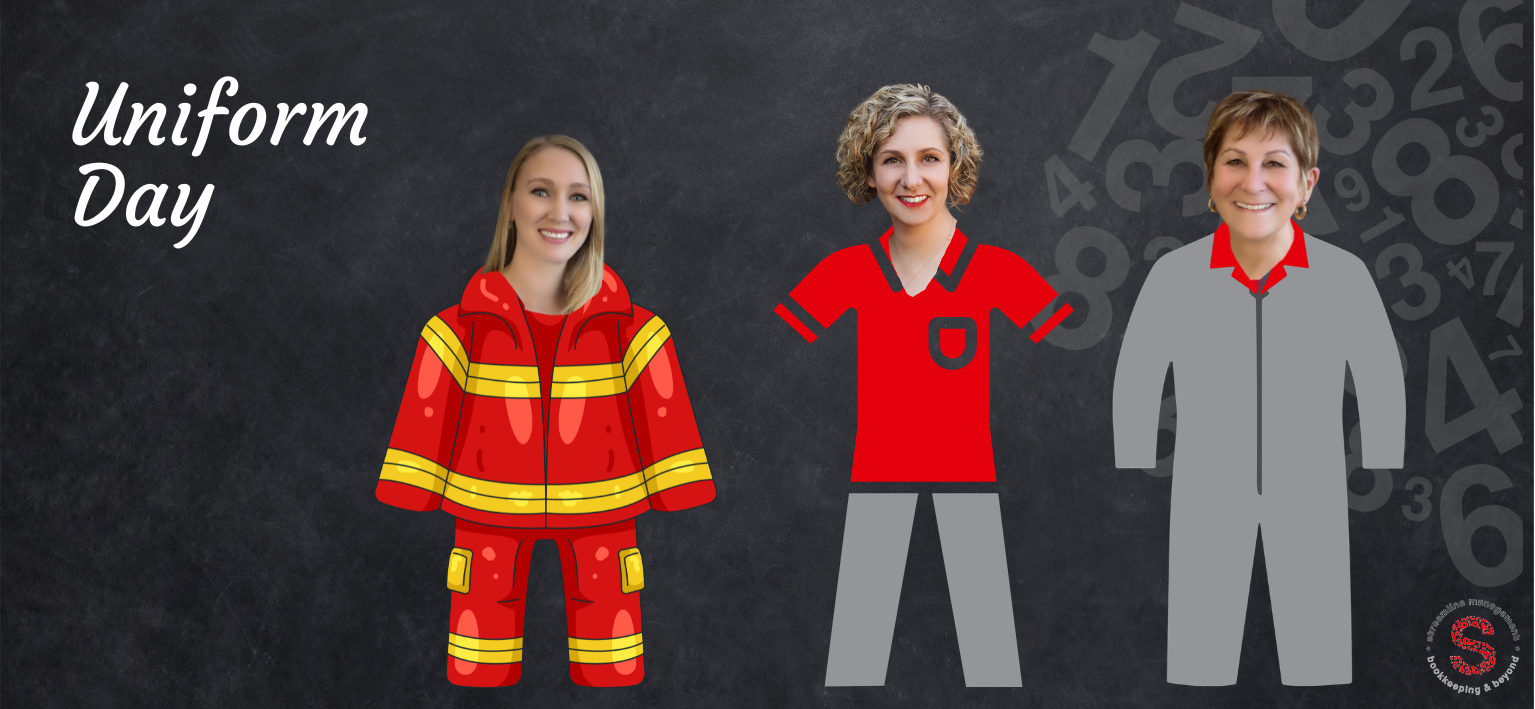
We all want to look the part, but the ATO isn’t keen on you just buying clothes you like, and claiming they are a ‘uniform’ for your small business. Protective equipment (steel capped boots, googles, hi-vis) are a different discussion, you’d be in trouble if your team don’t have these!
When it comes to clothing – it depends!
Here is how to tell if your team’s gear actually makes the cut.
Non compulsory uniform is only deductible where the clothing designs have been entered on the Register of Approved Occupational Clothing.
 What do you need to know to apply to the Register of Approved Occupational Clothing?
The design of the non-compulsory uniform must meet the Approved Occupational Clothing Guidelines. Some of the uniform design basics to meet the Guidelines are:
– The uniform must be a complete outfit with either a full body garment such as a dress, or a top and bottom garment such as a shirt and trousers, blouse and skirt.
– A company identifier, such as discrete logo, name or initials, must be permanently attached to all items in the uniform. This includes accessories.
– For clothing, the identifier or logo must be at least 80% of a 4cm square area.
– For accessories, such as a tie or scarf, the identifier or logo must be at least a 1cm square area.
– Identifiers or logos must be in a contrasting colour or shade to the garments they are attached to. They must be visible from 2m away.
– You must permanently attach the identifier or logo to each garment. This may include embroidering, iron on or heat seal.
– The entire garment range can have a maximum of 8 colours. This includes different shades of a colour. It excludes those found in the identifier or logo.
– There is a limit to the number of colour/pattern/print combinations allowed. We base this on the number of employees in a class.
– When the uniform is worn by different groups of employees, there must be a common theme. A common theme requires the same colour lower body garment to be worn by all employees.
– The uniform must be appropriate for the duties of the employee.
You can check the fine print and start your application here: https://business.gov.au/grants-and-programs/register-of-approved-occupational-clothing
A compulsory uniform must be prescribed by the employer in an expressed policy which makes it a requirement for a particular class of employees to wear that uniform while at work, and which identifies the relevant employer. The wearing of the uniform generally should be strictly and consistently enforced.
Where employees are required, as a strict condition of their employment, to wear at work single items of distinctive clothing, a deduction is allowable for the costs of this item of clothing.
Expenditure on a compulsory and distinctive uniform is deductible because the necessary connection exists between the expenditure and the occupation such that the essential character of the expense is work related and unique. The uniform needs to be sufficiently distinctive so that the casual observer can clearly identify the employee as working for the particular employer, or identify the products or services provided by the employer.
