
January – March 2024 super is due soon
March super contributions, must be received (by fund) by 28th April for employees (including working directors) and some sole trader contractors.
Severe penalties will apply for late payments

March super contributions, must be received (by fund) by 28th April for employees (including working directors) and some sole trader contractors.
Severe penalties will apply for late payments
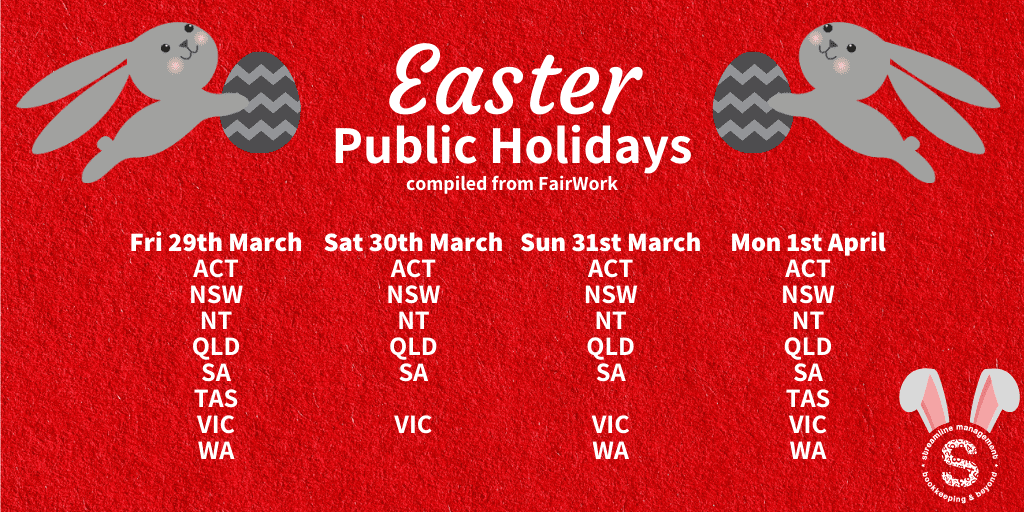
We’ll be closing the office for the long weekend, if you are closing too – be aware of the payroll implications.

The Fringe Benefits Tax year ends on 31st March, are you aware what might trigger this extra tax for your business?
A fringe benefit is like a payment to an employee, but in a different form to salary or wages.
Your tax agent can assist with calculations, lodgement, and what exemptions might apply. They may also assist you to make smarter decisions to avoid future lodgements and liabilities.
Can you tell the difference between an employee and a contractor?
Getting it wrong has become more expensive! Closing the loopholes changes to the Fair Work Act have increased penalties from 27th February 2024.
A sham contracting arrangement is when an employer attempts to disguise an employment relationship as a contractor relationship.

How do you show your team that you appreciate them?
If you’re thinking of conveying recognition with a gift – keep the fun business tax (or Fringe Benefits Tax if you want to use the technical term) in mind.
Employee of the month awards and a public pat on the back can also be powerful (and cost effective).

Are your team working their proper hours? Do you know what the proper hours are?
Fairwork says:
Maximum weekly hours form part of the National Employment Standards (NES). The NES apply to all employees covered by the national workplace relations system, regardless of any award, agreement or contract.
– maximum ordinary hours that can be worked in a day, week, fortnight or month
– minimum ordinary hours that can be worked in a day
– times of the day that ordinary hours can be worked this is called the spread of hours (for example, between 7am and 7pm).
The ‘spread of hours’ may catch you out if you allow your team to work flexible hours (after they’ve had dinner) – they still need to fit inside the spread of hours or you could be up for overtime rates!
On 6th December 2023 the ATO released a new Tax Ruling in response to a High Court decision about classifying workers.
We’ve trawled through various ATO pages and summarised it for you with links.
To work out if your worker is an employee or contractor, you need to determine whether your worker is serving in your business or is running their own business. You do this by reviewing the legal rights and obligations in the contract you entered into with your worker.
– Ask for help if you need it!

Don’t forget to keep staff take annual and/or sick leave balances up to date.

Public holidays – don’t forget your fairwork obligations!
You need to pay all full time and part time staff for the normal hours they would have worked on Australia Day if you close your workplace.
If you open your workplace, all employees have the right to not work. Employers can request employees to work on a public holiday, but the request has to be reasonable. An employee can refuse a request to work if the employee has reasonable grounds to refuse or the request is unreasonable. Check awards for payrates.
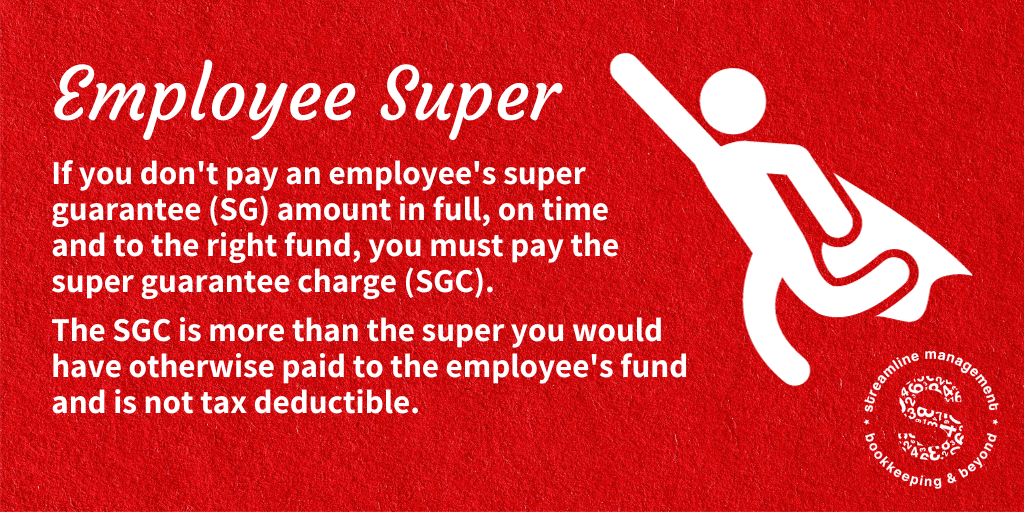
Super payment due dates occur quarterly. If you don’t pay an employee’s super guarantee (SG) amount in full, on time and to the right fund, you must pay the super guarantee charge (SGC).
The SGC is more than the super you would have otherwise paid to the employee’s fund and is not tax deductible.
You will need to complete an SGC statement and submit it to the ATO, this is used to calculate fines and penalties (some to compensate staff for lost earnings, some to punish you for naughtiness).
Hopefully this is a mistake you only make once!
